Consensus in Distributed Systems: Understanding the Raft Algorithm
Raft: Why Simplicity Wins in Distributed Consensus

Introduction
Consider a group of friends planning a weekend outing. To make the trip successful, they need consensus on the location, schedule, and budget. Typically, one person is chosen as the leader — responsible for decisions, tracking expenses, and keeping everyone informed, including any new members who join later. If the leader steps down, the group elects another to maintain continuity.
In distributed computing, clusters of servers face a similar challenge — they must agree on shared state and decisions. This is achieved through Consensus Protocols. Among the most well-known are Viewstamped Replication (VSR), Zookeeper Atomic Broadcast (ZAB), Paxos and Raft. In this article, we will explore Raft — designed to be more understandable while ensuring reliability in distributed systems.
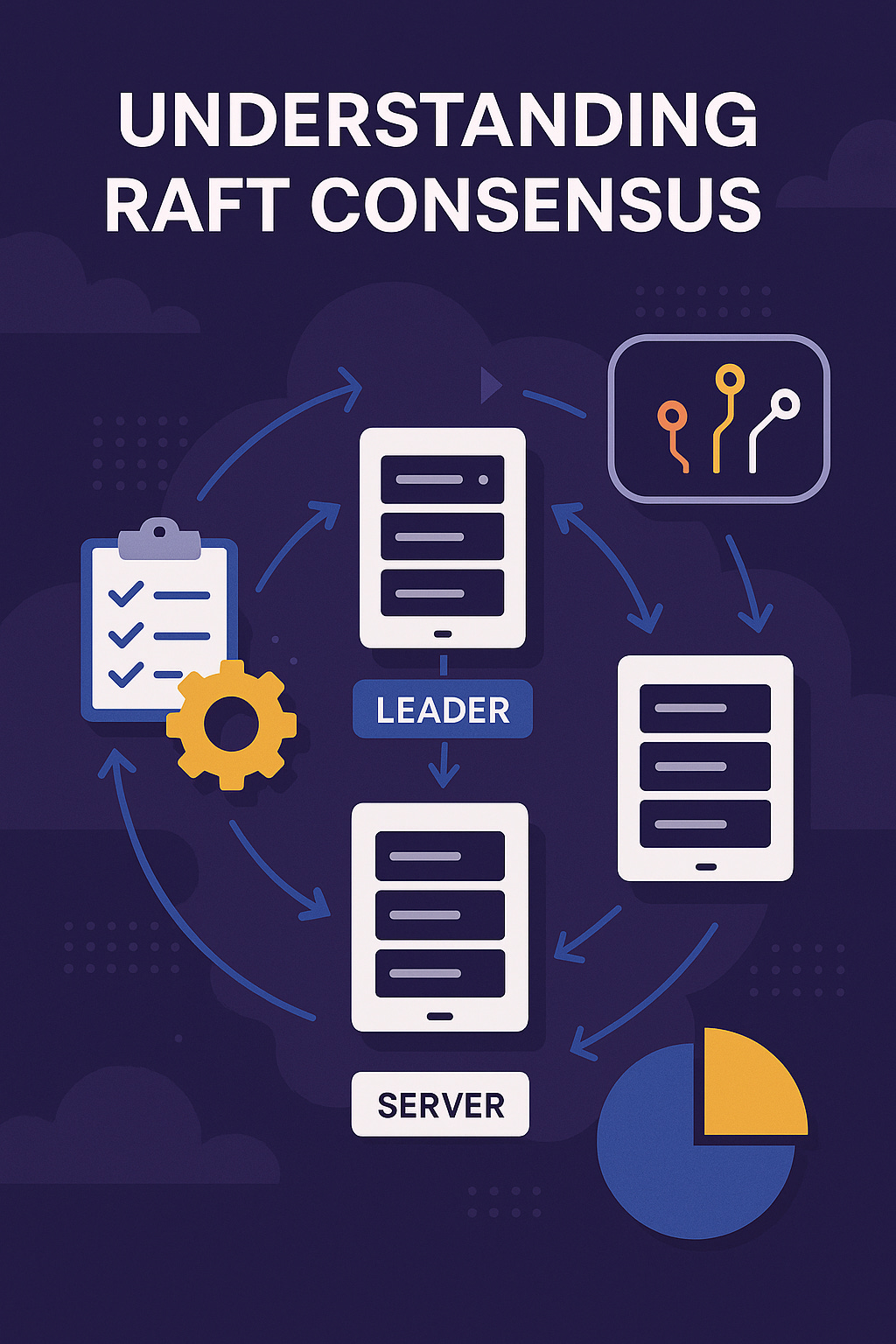
Consensus in Distributed Computing
Consensus in its simplest form refers to a general agreement. In the weekend outing analogy, it refers to all friends agreeing to a location. Its quite likely that several options are considered before the group eventually agree on a particular location.
In distributed computing too, one or more nodes may propose values. Of all these values one of it need to be agreed upon by all the nodes. Its up to the consensus algorithm to decide upon one of these values and propagate the decision to all the nodes.
Formally, a consensus algorithm must satisfy below properties →
Uniform agreement → All the nodes agree upon the same value — even if the node itself has proposed a different value initially.
Integrity → Once a value is agreed by the node, it shouldn’t change.
Validity → If a node agrees to a value, it must have been proposed at least by one another node too.
Termination → Eventually every participating node agrees upon a value.
The uniform agreement and integrity forms the core idea of consensus — everyone agree on same value, and once decided, its final.
The validity property ensures elimination of trivial behavior wherein a node agrees to a value irrespective of what has been proposed.
The termination property ensures fault tolerance. If one or more nodes fails the cluster should progress and eventually agree upon a value. This also eliminate the possibility of a dictator node which takes all decisions and jeopardies the whole cluster in case it fails.
Of course, if all the nodes fails the algorithm can’t proceed. There is a limit to number of failures a algorithm can tolerate. A algorithm that can correctly guarantee consensus amongst n nodes of which at most t fail is said to be t-resilient.
In essence termination property can be termed as liveness guarantee while rest three as safety guarantee.
Raft
Raft stands for Reliable, Replicated, Redundant, And Fault-Tolerant, reflecting its design principles in distributed systems. It ensures reliability by maintaining consistent logs, replication across nodes for durability, redundancy to avoid single points of failure, and fault tolerance to continue operating despite crashes or network issues. Together, these qualities make Raft a robust consensus algorithm for distributed computing.
Explanation
Raft utilizes leader approach to achieve consensus. In a Raft cluster a node is either a leader or a follower. A node could also be a candidate for a brief duration when a leader is unavailable i.e. leader election is underway.
The cluster has one and only one elected leader which is fully responsible for managing log replication on the other nodes of the cluster. It means that the leader can decide between it and the other nodes without consulting other nodes. A leader leads until it fails or disconnects, in which case remaining nodes elect a new leader.
Fundamentally thus the consensus problem is broken into two independent sub-problem in Raft as Leader Election and Log Replication.
Leader Election
Leader election in Raft occurs when the current leader fails or during initialization. Each election begins a new term, a time period in which a leader must be chosen. A node becomes a candidate if it doesn’t receive heart beats from a leader within the election timeout. It then increments the term, votes for itself, and requests votes from others. Nodes vote once per term, on first-come-first-served basis. A candidate wins if it secures a majority; otherwise, initiating a new term and election. Randomized timeouts reduce split votes by staggering candidate starts, ensuring quicker resolution and stable leadership through heartbeat messages.
Raft is not Byzantine fault tolerant; the nodes trust the elected leader, and the algorithm assumes all participants are trustworthy.
Log Replication
The leader manages client requests and ensures consistency across the cluster. Each request is appended to the leader’s log and sent to followers. If followers are unavailable, the leader retries until replication succeeds.
Once a majority of followers confirm replication, the entry is committed, applied to the leader’s own state, and considered durable. This also commits prior entries, which followers then apply to their own state, maintaining log consistency across cluster.
In case a leader crashes, inconsistencies may arise if some entries were not fully replicated. A new leader resolves this by reconciling logs. It identifies the last matching entry with each follower, deletes conflicting entries in their logs, and replaces them with its own. Thus ensuring consistency even after failures.
Additional Considerations
Raft algorithm has below additional consideration for a robust consensus algorithm for distributed computing.
Safety Guarantee
Raft ensure below safety guarantees →
Election safety → at most one leader can be elected in a given term.
Leader append-only → a leader can only append new entries to its logs (it can neither overwrite nor delete entries).
Log matching → if two logs contain an entry with the same index and term, then the logs are identical in all entries up through the given index.
Leader completeness → if a log entry is committed in a given term then it will be present in the logs of the leaders since this term.
State safety → if a node has applied a particular log entry to its state , then no other node may apply a different command for the same log.
Cluster Membership Changes
Raft handles cluster membership changes using joint consensus, a transitional phase where both old and new configurations overlap.
During this phase, log entries must be committed to both sets, leaders can come from either, and elections require majorities from both. Once new configuration is replicated to a majority of its nodes, the system fully transitions.
Raft also addresses below three challenges →
New nodes without logs are excluded from majorities until caught up.
Leaders not in new configuration step down to followers.
Nodes still with old configuration that still recognize a leader ignore disruptive vote requests.
Log Compaction
Log compaction in Raft works by nodes taking snapshots of committed log entries, storing them with the last index and term. Leaders send these snapshots to lagging nodes, which then discard their log entirely or truncate it up to the snapshot’s latest entry. This also ensures durability in Raft.
Limitations of Raft
Raft has its own limitations with trades off scalability and flexibility as compared to other consensus algorithms.
Leader Bottleneck → Raft relies heavily on a single leader to coordinate log replication. If the leader fails, the system pauses until a new leader is elected, which can slow progress.
Scaling → Raft doesn’t scale well to very large clusters — leader elections and log replication become slower and riskier as the number of nodes grows.
Network partitions → this can cause temporary unavailability, since Raft prioritizes consistency over availability. An edge case exist where the elected leader is forced to resign and leadership switched between nodes continuously. Thus, forcing whole cluster to halt.
Real World Production Usage of Raft
Etcd uses Raft to manage a highly-available replicated log — utilized primarily in Kubernetes cluster for configuration management.
Neo4j uses Raft to ensure consistency and safety.
Apache Kafka Raft (KRaft) uses Raft for metadata management. In the recent version KRaft replaced Apache Zookeeper in Kafka.
Camunda uses the Raft consensus algorithm for data replication.
Raft vs Paxos
Raft was introduced to make consensus easier to understand and implement compared to Paxos. While Paxos is theoretically robust, it’s notoriously complex, making it hard for engineers to build reliable systems from it. Raft simplifies the process by breaking consensus into clear steps — leader election, log replication, and safety — without sacrificing correctness. This clarity makes Raft more approachable for real-world distributed systems.
When to Choose
Raft → Useful when building new distributed systems where clarity, maintainability, and developer adoption matter (e.g., databases, coordination services).
Paxos → Useful in academic or highly specialized systems where theoretical rigor is prioritized over ease of implementation.
In practice, Raft is usually the better choice for modern engineering teams because it balances correctness with simplicity.
Future Trends in Consensus
Future consensus algorithms are moving beyond leader-based models like Raft and Paxos. A key trend is leaderless consensus, where no single node coordinates decisions. Instead, all nodes collaborate equally, reducing the risk of a single point of failure. This makes systems more resilient and fair, especially in global networks where reliability is critical. For example, in blockchain or distributed databases, leaderless designs help ensure trust and consistency without relying on one “boss” node.
Another trend is scalability-focused consensus, which aims to cut down communication overhead. As systems grow to thousands of nodes, traditional methods struggle with efficiency. New protocols are exploring ways to minimize message exchanges while still guaranteeing agreement.
Also hybrid approaches are explored combining leaderless designs with probabilistic or quorum-based methods. These balance speed and fault tolerance, making them suitable for high-performance applications.
Finally, energy-efficient consensus is gaining attention, especially in blockchain, where proof-of-work is costly. Future algorithms will likely emphasize greener, lightweight mechanisms.
Consensus is evolving toward fairness, scalability, and sustainability — ensuring distributed systems can handle global scale without sacrificing reliability.
Conclusion
Raft simplifies the complex world of distributed consensus by breaking it into clear steps — leader election, log replication, and safety guarantees. While engineers may not encounter Raft every day, understanding it is essential when making architectural or design decisions for systems that demand reliability and consistency.
Raft ensures that clusters agree on shared state even in the face of failures, though it comes with trade‑offs like leader bottlenecks and limited scalability.
Its adoption in tools such as etcd, Kafka, and Neo4j shows its practical importance. Compared to Paxos, Raft is easier to grasp and implement, making it a strong foundation for modern distributed systems.
As consensus evolves toward leaderless and scalable designs, Raft remains a critical concept every architect should be aware of when shaping resilient, fault‑tolerant solutions.